500-page PDF + Markdown edition
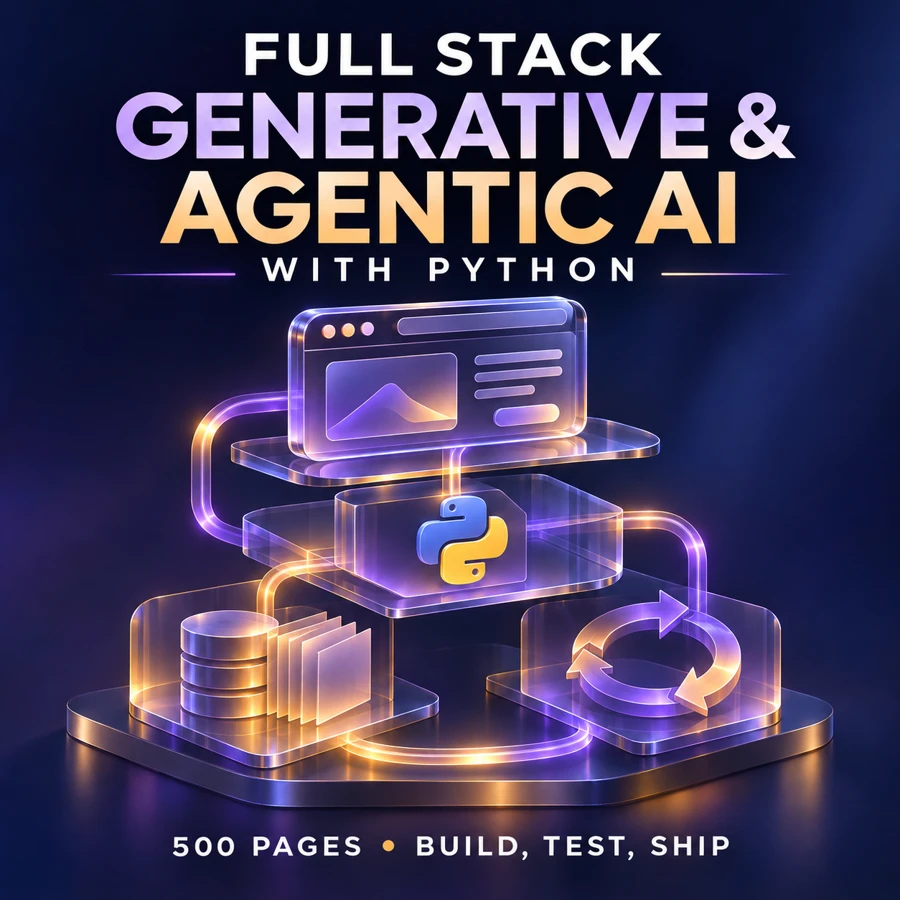
Concepts, original architecture diagrams, runnable fixtures, code, labs, troubleshooting, and writing space. One generated cover; technical visuals use inspectable diagrams.
PYTHON / APPLICATION ENGINEERING
Go from a model response to a working product. Connect the browser, Python backend, evidence, tools, and evaluations with Full Stack Generative & Agentic AI with Python.
One-time purchase · PDF + runnable source + complete local project
180 chapter verification blocks. Passed on CPython 3.11.9 and 3.12.14 Windows. The FastAPI project passed 19 unittest methods on 3.12.14, including fresh ZIP extraction and fake live transport. No paid model call was made.
THINK IN BOUNDARIES
A response is a candidate. Your application owns validation, permissions, evidence, budgets, and approval. Learn where each rule belongs before adding another framework.
The default project runs locally with lexical retrieval and an extractive offline answer. Live model integration is an explicit extension.
Conceptual architecture. Arrows move data; they do not grant permission.
A COMPLETE LEARNING PATH
For readers who can write basic Python functions and use a terminal. No prior retrieval or agent framework experience required. Open a unit to see its six chapters.
THE DOWNLOADABLE PROJECT / STUDIO
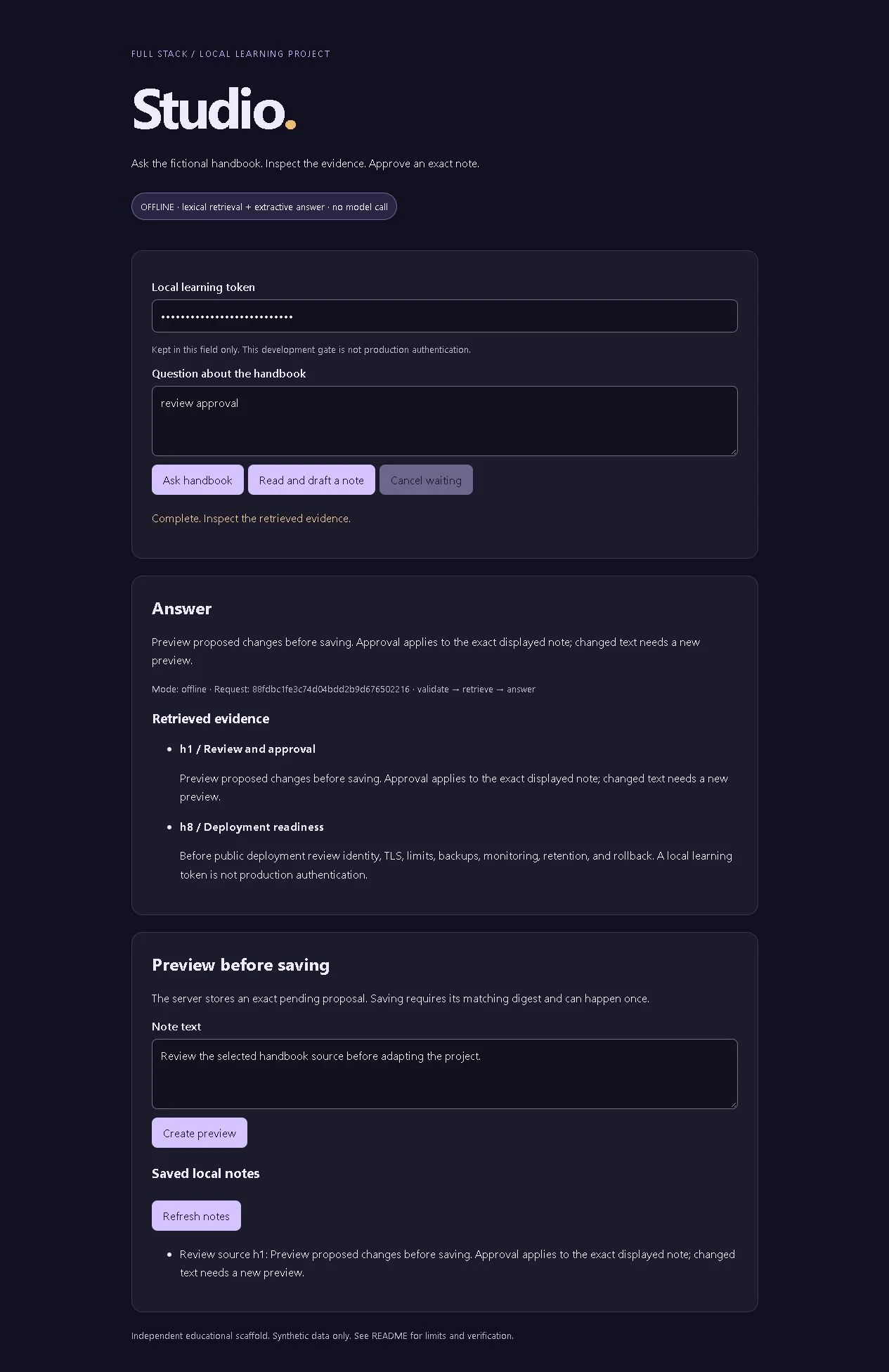
A real browser interface backed by FastAPI, SQLite, a synthetic corpus, and a bounded read-and-draft workflow. Run it locally, inspect every boundary, and adapt the source.
Actual project screenshot. Offline behavior is deterministic; this is an educational scaffold with documented production gaps, not a hosted AI service or production login system.
ACTUAL BOOK PAGES
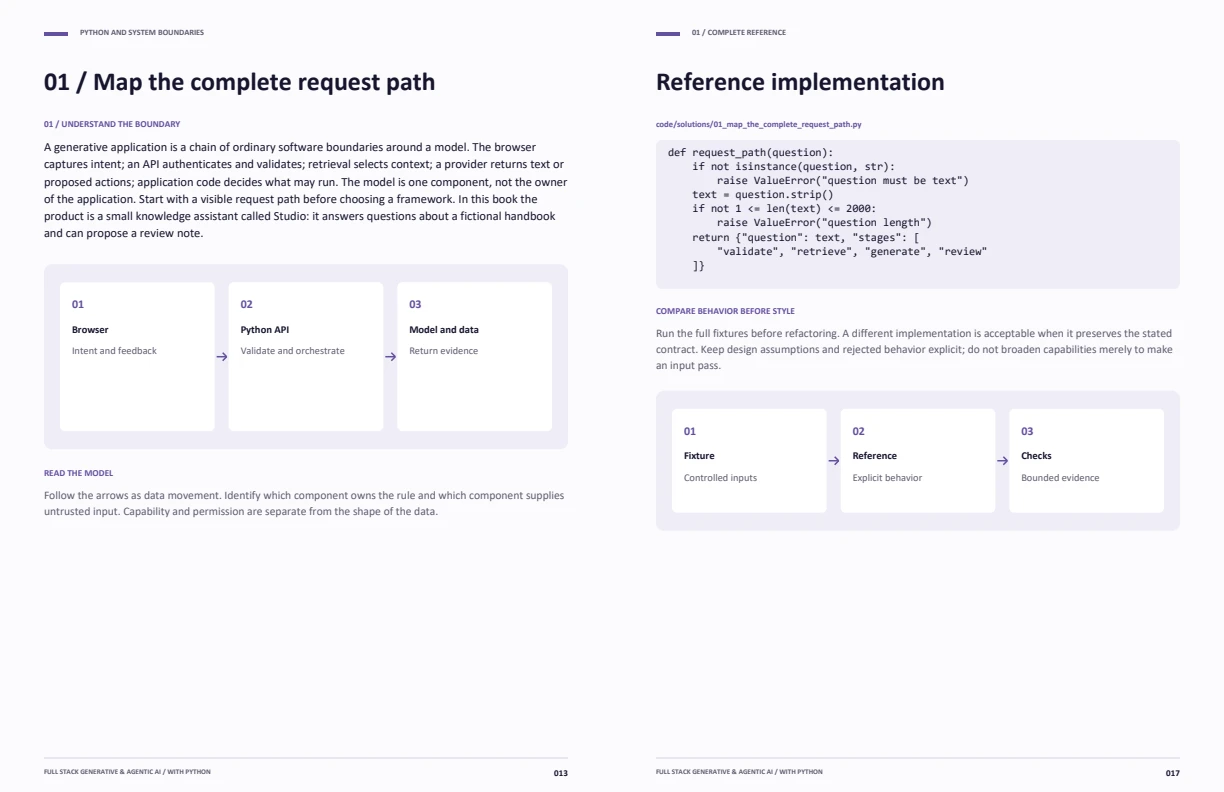
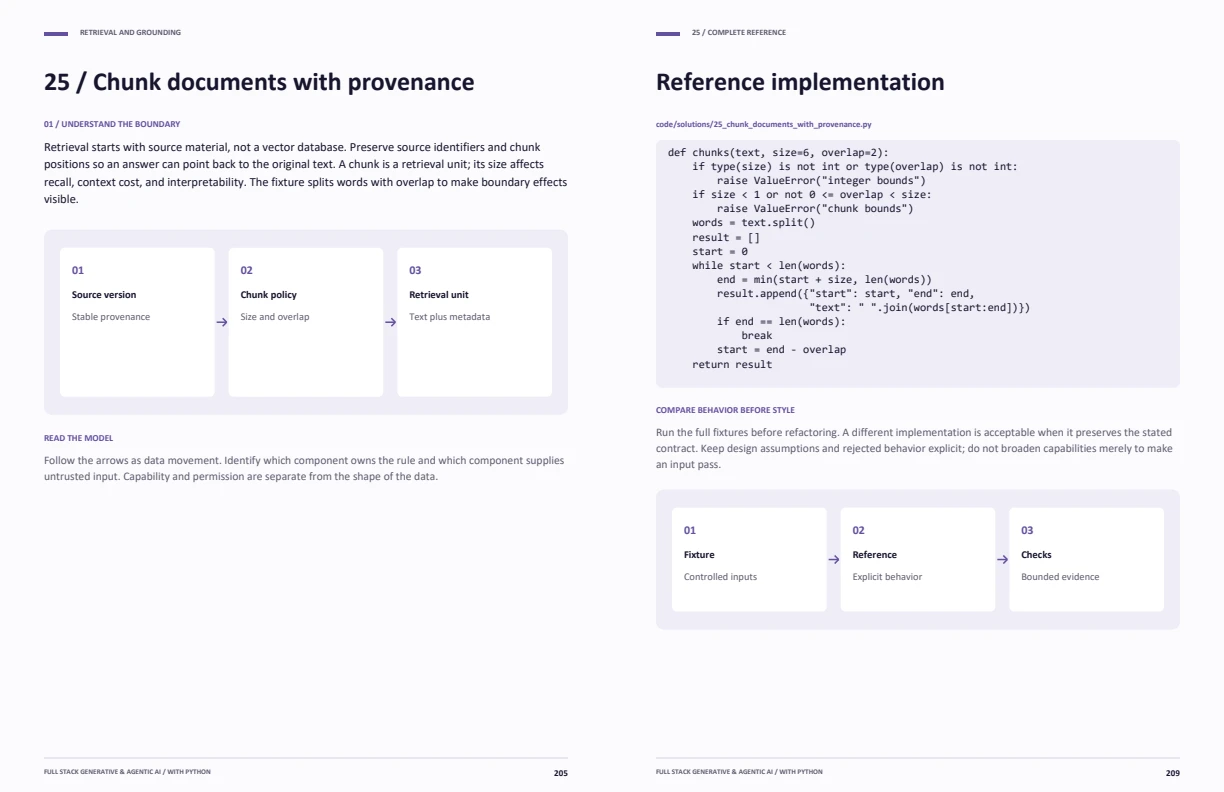
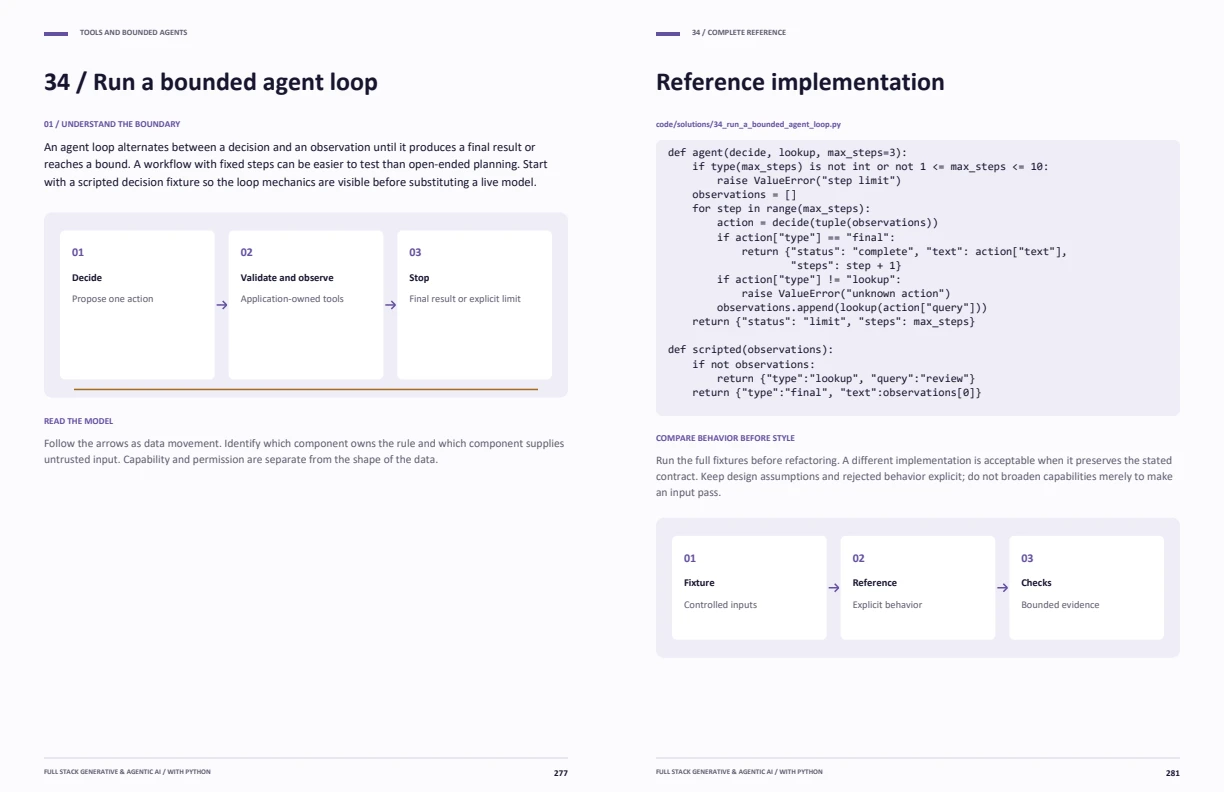
Each eight-page chapter includes the concept, design decision, observed demonstration, practice lab, complete reference, checks, failure case, and transfer exercise.
YOUR COMPLETE DOWNLOAD
Concepts, original architecture diagrams, runnable fixtures, code, labs, troubleshooting, and writing space. One generated cover; technical visuals use inspectable diagrams.
60 examples + 60 reference solutions, 180 trusted verification blocks, and a standard-library runner. No paid API required.
FastAPI, browser JavaScript, SQLite, synthetic corpus, eight retrieval fixtures, 19 test methods, and an exact dependency lock.
Editable project records, three CSV templates, learning route, primary resources, and a four-page planner repeating selected book pages. Optional text-only live adapter is fake-transport tested.
FULL STACK GENERATIVE & AGENTIC AI WITH PYTHON
Build an application you can inspect, test, and explain.
Independent self-study guide. No accreditation, certificate, job promise, or production-readiness guarantee.
One-time base price. Checkout calculates applicable taxes.
Get the guide & project ↗Digital download through Gumroad.
PDF · source · project · templates
BEFORE YOU BEGIN
Twelve opening pages, sixty eight-page chapters, and eight reference/planning pages. The format includes diagrams, code, demonstrations, exercises, diagnostics, transfer work, and writing spaces. It is a guided lab book, not 500 pages of continuous prose.
No, for the default exercises and local project. Chapter programs use the standard library. The FastAPI project needs internet access to install its dependencies, then runs without model access. Live experiments require your own provider access and may incur separate charges.
The shipped app uses lexical retrieval, an extractive offline answer, and a fixed bounded read-and-draft workflow. The book teaches model adapters, vector concepts, tool calling, streaming, and durable workflows with controlled exercises. A live text adapter is included as an opt-in extension, not wired into the app. No learned embeddings or live model evaluation are claimed.
120 chapter programs and 180 verification blocks on CPython 3.11.9 and 3.12.14 Windows. The project passed 19 unittest methods on 3.12.14 with its pinned dependencies, including fresh ZIP extraction and fake live transport. Browser checks covered answers, no evidence, wrong-token errors, preview/commit, and narrow-screen layout. No cloud AI deployment, container execution, production audit, or live model-quality benchmark was performed.
Yes. You may adapt the supplied code and templates for personal and commercial projects. Purchase does not grant resale or redistribution rights to the ebook, artwork, or complete bundle. Third-party packages retain their own licenses.
It is an independent application-engineering guide. Basic Python functions, dictionaries, exceptions, and terminal use are expected. No formal certificate, accreditation, employment outcome, or affiliation with a provider or university is implied.